Saturday, December 1, 2012

A Quebec Grave


On a trip in 1991 to find our ancestors south of Montreal, my brother and I and our two sons were combing a certain graveyard where we had already found our main ancestors. 


We came across a grave that absolutely stunned us.

There is a certain serenity in looking through graveyards and reading gravestones for what they tell us about life long ago. And it was in this lighthearted manner that we were prowling through these cemeteries. We first found our earliest known ancestors' graves and found also that they had lived to ripe old ages of 83. Certainly a ripe old age for that day.

But then we came across a grave that we will not soon forget. It was a large grave for a great, great aunt (my great great grandmother's sister). But it was the grave next to hers that stunned us. It was a long stone, perhaps 4 or 5 feet in length and only 2 no more than 3 feet in height. And the top was rounded into four curved tops so that while it was one piece of stone, it looked like four little stones in one.

As we walked closer to this oddly shaped stone, we began to wonder what it could be. Then the horror became clear as we read the names and the dates of death. Four children. All died in 1877. All died in June of 1877. All died within 8 days of one another.

A three year old named Ellen died first on June 6th. Her brother Frank died the next day at age 5. John, aged 10 died 2 days later and finally the infant, Philip died on the 13th. He had just turned one.

We began to imagine what could have happened. A fire? No, they probably would have all died the same day. A person gone berserk? Possible but pretty far fetched. Alas, an all too common explanation for those days. Diphtheria. Influenza. Typhoid. Measles.

Childhood diseases that few children die of anymore in our country at least. It is hard to imagine the horror of that June for that family. I have thought a lot lately about that family, the long sleepless nights. The cries of the children. The whimpering. The helplessness of the adults. The wiping of perspiring brows. The pacing. The waiting. The hoping beyond hope. And I wonder, did John, the 10 year old, know when his 3 year old sister and his 5 year old brother died? Or was he mercifully delirious and oblivious of the death that surrounded him?

Then finally came death. Swiftly. In one week all the children were gone. One son survived only because he was in his mother's womb. Thomas Joseph was born in 1877 several months after that bitter June.

We stood and stared at that tombstone which was really four little tombstones. And the two boys, my son Ryan and my brother's son, Brian, who take great pride in standing up to any Steven King or slasher movie ever made, were visible shaken by these stones and the story they told by their silent witness.

As we looked closer we saw engraving on the front of the base on which the grave stones sat. Carved in what looked like a black basalt rock and overgrown with grass making it very hard to read. We pushed back the grass and there were these words, "Goodbye dear mother and father. We go to prepare a place for you in heaven. While we were with you, we did not belong to you but only to our faithful savior Jesus Christ, the Good Shepherd, who cares for us now."

There were many other things to see on our trip to the farming area south of Montreal, but this grave stands out in our memory. For when we speak of the valley of the shadow of death, we rarely imagine a week like my great aunt and uncle had in that awful June of 1877. It is hard for us to imagine a valley so deep and dark as that.

And yet, death is death. And grief is grief. And the good Shepherd is the Good Shepherd.

Saturday, June 23, 2012

The Job Question

Not the question facing the Obama administration and the Romney candidacy. Not "Jahb" but "Jobe". The good guy that has bad things happen to him. The question goes, "Why would a good and all powerful God allow evil to prevail and the innocent to suffer?"
Never mind the oddness of the story. If I were not a believer, this piece of scripture would be altogether easy to ridicule. Satan makes a bet with God that he (Satan) could get his most righteous servant to denounce the almighty God. God agrees to the bet (oh good Lord--are you kidding me? Who wrote this, Aaron Sorkin?).
God takes everything away from his righteous servant Job (not Steve). The list of what Job loses is almost endless. And then he and his buddy Satan sits back to see what happens. What they are waiting for, of course, is for Job to curse God. He doesn't of course, but along the way, he makes some serious accusations, Job 10:8-10:

“Your hands shaped me and made me.

    Will you now turn and destroy me? 

Remember that you molded me like clay. 

    Will you now turn me to dust again? 

Did you not pour me out like milk

    and curdle me like cheese,
I'm a Wisconsin guy, so the idea of God curdling me is interesting if not out-right affectionate.
 Aren't you "in charge" Holy God?" If so, why must we put up with this contradictory nonsense about the good suffering and the evil getting all the good stuff?
So, God responds to Job's temerity with a juggernaut of a response out of the whirlwind. "who is this that darkens counsel without knowledge?

Forgive me, but this sounds too much like "pay no attention to the man behind the curtain" from the Wizard of Oz"
Brace  yourself like an man and I will answer you.
Wow!
Well, what is the answer to this bedeviling question about God's responsibility for evil?

Tom Are Jr. has this quiet and moving resolution from his own experience
I took my four-year-old daughter to the emergency room. Sarah had fallen and needed three little stitches in her bottom lip. The nurses strapped her into a velcro blanket they called a "papoose." it wraps around a child so that she cannot move. Sarah cried. they placed the sterile filed over her face with the hole over her bleeding lower lip. I searched for her hands to hold. They were plastered to h er side, unable to move. She looked through a little hole in the sterile sheet while the instruments darted in and out. She cried, "Daddy make them stop. Make them stop Daddy, please. Daddy it hurts!" "Be still sweet heart. It will be alright," I said, feeling anything but alright myself. "Hold on. Daddy's right here. Daddy's right here." "But Daddy it hurts. Make them stop!" It was accusation. It was plea. it was prayer.
Eventually the process was over and the medical staff took off the papoose. Then Sarah jumped into her father's arms. Her petitions to "make them stop" went unanswered. Her father hadn't stopped them. But now she just "clung to me with an unwavering trust." She didn't cast her father aside as one who was not capable of fulfilling the most simple of promises. She didn't walk or run away. She clung tightly to him because she believes that he is the one who will be there for her beyond the evidence to the contrary notwithstanding.
Suffering is a reality and God's place in it is just trustworthy if we are stubborn enough to believe that.

Saturday, June 16, 2012


While I sit drinking my Wittenberg Beer with Philip and Amsdorf, the Gospel runs its course and overthrows empires. -- Martin Luther

Karl Barth connects this Martin Luther quote to the Gospel lesson for tomorrow, Mark 4:26ff Unlike Jesus Kingdom parables about building houses, this parable makes clear that the Kingdom of God will come whether we work at it or not. Building buildings needs stone masons, carpenters, joiners, roofers and on and on. The growth of the Kingdom of God as progress from seed to plant will happen whether one "sets hands to work or folds them or even lays them in [our] lap [we] can only be a spectator and affirm that it takes place "He knoweth not how" (Mark 4:28)--in a process which continues both when he works and also when he does not, but is perhaps, in the words of Luther, while, "Drinking beer with Philip and Amsdorf" (Philip Melanchthon and Nicolaus von Amsdorf)
Barth goes on (Book IV, vol 2 pp632 ff) to contrast these two parables of building and sowing
It is a matter of their [Christians] spiritual growth, and not therefore of a growth which they themselves can direct. It will continually have for them the greatest of surprises, sometimes glad and sometime bitter. In moments when [the church] is resolved to offer "reasonable service," the plans and efforts of Christians will have to be ruled by it, and not the reverse. To their own astonishment it will continually exalt the lowly, enrich the poor, give joy to the sad and make heroes of the feeble.... And as it grows spiritually, there is no compulsion but it may grow in the first way, extensively and numerically. (p. 650.)
 What are the marks of such growth? Barth lists them nicely:

  • growth in faith (2Cor 10:15)
  • increase in love (2 Thess 1:3)
  • increase in the knowledge of God (Col 1:10ff) with strengthening endurance and joyful patience.
  • growth in the fruits of righteousness (2Cor 9:10)
  • growth in grace (2 Pet 3:18)
  • Incrase of comfort (2 Cor 1:5)
  • Thanksgiving (2 Cor 4:15)
  • the grace for every good work (2 Cor 9:8)
  • Hope (Rom 15:13)
  • enrichment of love in knowledge and understanding (Phil 1:9)
And then he summarizes by saying that the increase of growth for the Christian Community is "both horizontal and vertical" and is the spiritual progress of the sancti in their relationship to the sancta.


Saturday, May 26, 2012


Back in the day, Paul Tillich was the most liberal of all theologians. Well, not entirely true, of course. There was John A. T. Robinson (not to be confused with the Mayflower's pastor) and, of course, our good friend Rudy Bultmann. But in the mainstream, Tillich was pretty liberating for this twenty-something guy who wanted to go into the profession of pastoral ministry.


He was, after all, a "religious socialist" and while I wasn't too sure what that meant exactly, I did like the turn of phrase. It made him a radical on this continent, his adopted home, and I liked the idea of being his intellectual friend but certainly not his equal.


But now, when I sneak back into the Tillichian territory, I find him marvelously orthodox even confessional. In preparing for tomorrow's sermon on Romans 8 I find myself in his debt in marvelous ways. First of all, he uses the Revised Standard Version rendering of "sighs too deep for words." The RSV was the only "mainline" option in those days. Published in the mid 1940s it was all we had then besides the King James Version (or as so many of my parishioners say, the "Saint James Version.") But on this particular phrase, the RSV gets it just right. 


Likewise the Spirit helps us in our weakness; for we do not know how to pray as we ought, but the Spirit himself intercedes for us with sighs too deep for word. And he who searches the hearts of men knows what is the mind of the Spirit , because the Spirit intercedes for the saints according to the will of God.

The King James version has "groanings that cannot be uttered." Not bad, but this most poetic of all translations misses the poetic mark while, as always, remaining most faithful to the Greek: στεναγμοῖς ἀλαλήτοις Groanings that cannot be uttered. Groanings is just not the right word there, it seems to me. 


Luther's translation uses "mit unaussprechlichem Seufzen" --unspeakable sighings. Just right.


Back to my friend Tillich.


He notes the marvelous contradiction in Paul who certainly knew how to pray--he was trained as a Pharisee, who can pray better than they? But because of that he knew that he did not know how to pray and found himself in need of the Spirit of God to help him "pray as we ought."


I'm a professional who does a lot of praying in public. If I'm in a public space and there is need of a prayer, I'm always asked to pray. I am, after all a professional and I always oblige. I say, "Let us pray" and then launch into some sort of formulaic prayer that I have likely prayed many times. 


I pray publicly pretty well. I get compliments on my prayers. But they are all pretty self-conscious.


Tillich in his book The New Being has a marvelous chapter on this very passage from Romans 8. In it he notes that there are two kinds of prayer. The fixed liturgical prayer and a free spontaneous prayer and both are important but lacking in a certain way. 


The first is lacking because while poetic (the best prayers are written by poets) they become "mechanical or incomprehensible or both." Even the "Jesus Prayer" or the "our Father." Jesus said, "Pray like this" not "Pray this." And yet this may be our only universally memorized prayer.


I have a good friend who is an Episcopalian priest who confesses that he doesn't know how to pray spontaneously. All the prayers he is confident about are written out. He is suspicious of prayers that use the phrase, "Oh Jesus we just come to you..." He calls them "wejus" prayers. The Evangelicals pray in this way. It is an attempt at humility and while they have the gift of spontaneity, they often lack poetry. "We are not better off" Tillich says. Spontaneous prayer is a prayer addressed to someone called God but seems more addressed to someone "who is actually another man to whom we tell things, often at great length, to whom we give thanks and of whom we ask favors." Such prayers don't prove we "know how to pray as we ought."


The liturgical Churches which use classical formulas should ask themselves whether they do not prevent the people of our time from praying as they honestly can. And the non-liturgical Churches who give the freedom to make up prayers at any moment, should ask themselves whether they do not profane prayer and deprive it of its mystery.
This is the day of Pentecost--the day of the Spirit and perhaps we should allow the Spirit to do the Spirit's work.
In a deep humility we ought, Tillich says, confess that we are in need of a most holy help in the art of prayer.


Prayer is humanly impossible Tillich says! 


We are having a conversation with somebody who is not our buddy nor ourselves, but someone who is nearer to us that we are to ourselves. We pray to someone who knows us better than we know ourselves. God knows "all the unconscious tendencies out of which our conscious words grow." Prayer is humanly impossible. We all have ulterior motives in our prayers and God, fortunately, knows them all.


Prayer must always begin with the confession that we don't know how to pray. Then and only then can real prayer begin.

Saturday, May 19, 2012

Butt Call


Acts 1:15-26, John 17:6-19

I got a “butt call” from my daughter, Erin. Actually, I think that the culprit was one year-old Janie who might have grabbed the iPhone out of her mother’s bag and pressed a quick dial function. I’m not sure about that, but entirely possible.
This is called a butt-call because it is often made because the cell phone is in the back pocket and somehow the screen performs the quick-dial function and makes the call.
In this case, I listened for as long as it was comfortable. It was like listtening in to their morning life. I yelled several times “HELLO”!  But there was no response. Luckily I couldn’t understand what anyone was saying, but it felt totally intimate. Marcos was talking with his mom and one year old Janie was just jabbering in the background and, as pleasant as it was to listen in to their life, I felt like I was spying on them.  So I hung up.
Here , in this Gospel lesson, we have an intimate conversation with Jesus and his Father. We’re eavesdropping aren’t we? We’re eavesdropping on a heavenly conversation between Jesus and His Father:
But now I am coming to you, and I speak these things in the world so that they may have my joy made complete in themselves. 14I have given them your word, and the world has hated them because they do not belong to the world, just as I do not belong to the world. I am not asking you to take them out of the world, but I ask you to protect them from the evil one. They do not belong to the world, just as I do not belong to the world.
Let’s remember the night in which this prayer took place.
This is the night of betrayal and hopelessness. This prayer is, in a certain way, Jesus’ last will and testament. This is it,
Father. I’ve done all I can and I pray that you will give Peter and John and James, Mary and the others all that they need to be about the witness they have been called to.
There is a feel to this final prayer that it all could fail, isn’t there? Behind this prayer is that this is a risky venture and the hope of all the world is in balance.
Jesus is turning things over to his own beloved and by implication is turning things over to us.
And I get the sense at least, that this is an enormously risky business.
A lot is at stake here.
Jesus said, “I am coming to you. I’m leaving here and I pray that you will give them all that they need to do the work I have begun.” Can Jesus trust entirely that this will happen? He is investing all that he is and was to this human enterprise. It’s a risky business at best.
Let’s look at the context of this risky prayer.
John 13, Jesus washes the disciples’ feet. A really shocking thing to do for the rabbi to wash his followers’ feet.
“No,” said Peter, “you shall never wash my feet.”
Jesus says: “If you do not let me wash your feet, you shall have no part in me.”
He washes Peter’s feet much to Peter’s chagrin and then says that we all should wash each other’s feet. Wash each other’s feet? Maybe in first century Judaism, but in 21st century America?
In the youth mission trips that we have been going on in these many years, we end the trip with foot washings. Always a risky business. At the end of the week the young adult leaders of YouthWorks wash the feet of the adult leaders of each church youth group at the mission. Then each adult moves from one set of feet of our youth to another washing their feet. It is always the most moving experience of my ministry.
Then, Jesus predicts his betrayal by Judas.
And then he predicts Peter’s denial. “Lord, I will lay down my life for you.”
Well, maybe not.
Then the tone shifts. Jesus comforts his loved ones. He’s already laid out how difficult it will all be. Now, he needs to say that he and his father will be with them to the end.
John 14: Let not your hearts be troubled.
I am the way and the truth and the light. Follow my way, and I will be with you.
Jesus then promises the disciples (and us) that the Holy Spirit who will come.
“I will not leave you as orphans… But in a little while, I will be with you.”
“Where you love one another, I will be there.”
But the Advocate, the Holy Spirit, whom the Father will send in my name, will teach you all things and will remind you of everything I have said to you.  Peace I leave with you; my peace I give you. I do not give to you as the world gives. Do not let your hearts be troubled and do not be afraid.
I am the vine and you are the branches.
 And you also must testify, for you have been with me from the beginning.
And here is the hook to the story from the book of Acts, chapter 1.
The first Crisis in the Church.
Judas has died, perhaps committed suicide, the record is not clear. The Medical examiner is still examining the details.
But there is a vacancy and how shall we fill it?
So they did a congregational self-study. You have done that before haven’t you?
A congregational self-study in preparation for new pastoral leadership.
It’s painful.
The congregation of the earliest church have measured their strengths and weaknesses (trying to be honest about both strengths and weaknesses).
They thought about what they needed in their replacement of Judas.
They asked for references for each of their candidates.
The first questions was, “Were you there from the baptism of Jesus to his crucifixion?” [check]
“Were you there at the cross itself” [well maybe not, they couldn’t find anyone with the appropriate moxie to be there]
“Did you deny our friend Jesus when others asked whether or not you knew him?”
“Oh, yeah, I know Peter, our CEO didn’t do well on that score. So, if you weren’t there on that one, I guess we can let it go”
Uh, were you there for the feeding of the 5000? Did you understand how that was done? No? Neither did we. [check]
So, in frustration, they had the position referred to an executive search agnecy.
They did the appropriate background checks.
They scored each candidate according to their ability to get new members,
their ability to preach powerful and redeeming sermons,
their qualifications regarding the healing of the sick,
and all came up short. Desperately short.
There were many who were around Jesus from his baptism to his crucifixion
Many more than I would have imagined as a simple reader of the Gospel accounts,
but all had one thing or another in their background check that made them look bad in one way or another.  Discounted them in one way or another.
The disciples were running out of time.
They were down to just two candidates: Joseph called Barsabbas (also known as Justus) and Matthias.
Those of us latter day saints who read the accounts in the Gospels have not heard of these two men. Did we miss these guys in the enumeration of all the friends of Jesus? I’m sure they were at the baptism and at the crucifixion, but we just have to take Luke’s word of this in his accounting in his telling of the book of Acts.
Let me go out on a limb here and say that they were as fault-filled as the rest of them. Or perhaps I should say, they were as fault-filled as the rest of us.
But they were all found to be as qualified as it gets.
Joe and Matt.
They both had their GED.
They both had done some apprenticeship in either fishing or accounting or carpentry. They could contribute something to the common life of this risky adventure that they were all beginning.
So there they were. Joe and Matt.
Both good guys to be sure. Or at least as good as guys were in these difficult post-crucifixion, post-resurrection times. All had failed, but these two had the minimum requirements. They were with Jesus from baptism to his ascension into heaven.
None of them, not the 11 nor any of the others who were there, could be said to understand any of what had taken place, but at least these two were there through it all.
And that’s all the requirements that were needed.
“Being there” seems to be all that was required.
The portfolios of Joe and Matt just read, “We were witnesses of these things from baptism to the ascension.”
Neither of them had to write a “blue book” essay explaining what it meant.
No multiple choice questions as I like to construct for my Confirmands.
They just had to “Be there.”
That has ever how it has been.
Moses wasn’t great at speach, but he was chosen.
Aaron, Moses’ brother, agreed to the fashioning of the golden calf, but he was a great speaker. Oh, well.
Peter, well, Peter was an exceptional case. What a hot mess he was. Said he would be there through thick and thin and wasn’t even there through thin.
So here it is:
God never calls the ones who are handsome or experienced or have a proven track record of any real sort.
God never calls the ones with advanced degrees in theology or computer sciences.
God calls ordinary people to do God’s extraordinary work.
Oh, dear Lord, let me say this again:
God calls ordinary people to do God’s extraordinary work.
God doesn’t call the qualified. God qualifies the called.
And God calls by some mystical process of drawing straws.
And Matthias is the one.
And then we never hear from him again.
The uncalled ones, Phillip and Stephen, are the first deacons and they get a real play in the on-going story. Stephen is the first martyr by stoning and Philip baptizes a Eunuch. Can you imagine such nonsense as this?
And to this day, invisible Christians everywhere are exemplars of the Gospel message even though they hide in the deep recesses of the emerging Christian story. They are not the Joel Osteens or the Rick Warrens (as powerful as their ministries may be). The unqualified saints work quietly as the elect in the most appropriate times and places—the right times and places to proclaim that Jesus Christ is come to the glory of God the Father, because God gives the glory and we only reflect it. Dimly.

Amen.


Saturday, May 5, 2012

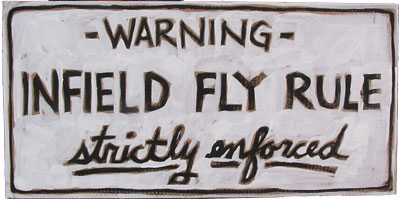
Confirmation and the In Field Fly Rule


Sermon Confirmation Sunday
May 6, 2012
John 15:4
Just as the branch cannot bear fruit by itself unless it abides in the vine, neither can you unless you abide in me.

I know I’ve said this before, but I love baseball
but I don’t know what the in-field fly rule is.

Well, actually, I’ve made this observation so many times that folks always feel the necessity of explaining the in-field fly rule to me.
So, in just the last two years or so, after a lifetime of loving baseball, I now know what the in-field fly rule is and more than that, I know why it’s on the rule books.
I stayed with my brother these last two days in Colorado Springs and he went over this rule with me for the umpteenth time.  He’s an umpire for several amateur leagues both softball and hardball, so he knows more the rules about baseball than anyone should.
The in-field fly rule is this:
If a ball is hit in a pop-up that lands in the infield and there are fewer than two outs and that there are runners on first and second OR the bases are loaded. The batter is OUT regardless of whether the ball is caught by any player in the field.
It’s a strange rule at first glance, I know, but it is a good rule and I now know why it needs to be there.
But, not knowing about this rule or why it’s important has not interfered with my love of baseball for lo, these many years. When, in the rare instance that the in-field fly rule is invoked and the batter is ruled out even though no one caught the ball on the fly or tagged any player out, the announcer might say, “The batter is out--in field fly rule.” I might be perplexed by that announcement or I might have just taken a bite of my hot dog and a slug of my soda and not noticed.
On those equally rare occasions when I’m sitting next to a guy like my brother, they might say, “in-field fly rule”. And I would say, “Oh.”
Well, I think that going to church is a lot like this. You need to know a little bit about the church and its worship, but you don’t need to know everything.
You need to know the basics and that is what Confirmation is intended to be.
We learn the Lord’s Prayer, the Doxology, and the 10 Commandments. We learn a bit about the meaning of Holy Communion and about how Jesus is present next to us when we take it.
We need to know something about the sacrament of Baptism--that it is a rite of initiation into the church, a “sacrament of belonging” as the Jesuits put it--but that it might not have much to do with the washing away of original sin as if a child is born with such a condition.
We need to know something about God’s love for us which transcends our every betrayal of God and God’s love for the world.
We need to know about GRACE.
Those things are key it seems to me.
But you don’t need to know everything about the faith.
The Church in its long history has hundreds of “In field fly rules” that govern its life, but you don’t need to know them all in order to be a saint in the body of Christ.
I find that most of the “in-field fly rules” in the church are written in Latin.
“ex opere operatum”,
“Extra ecclesia nolo salus.”
“simil justis et peccare.”
I think these are all treasured formulas to understanding the difficult twists and turns of the faith, but there will be plenty of time to learn about them. I won’t spend time explaining them this morning.
What you need, in the faith, is to be a partner with others in this faith journey.
As a friend of mine at our meeting in Colorado this past week said, “You don’t need a PhD in systematic theology or biblical hermeneutics (that’s one of those in-field fly-rules). All you need is to be with folks whom you trust and just look over their shoulders for a while.”
I remember when I first started attending a United Church of Christ -- well, an E and R Church since it was before the merger that created the UCC --  when I first started attending my church, I held a hymnal in my hands and sat next to my buddy Allen Wallenschlager. I was just 10 years old when I started attending that Church.  My parents were never members of any church, so I attended church with my grade school friends, not with my parents. My parents never forced me to go to confirmation. In fact, I don’t really think they knew what Confirmation was but they were patient with me in my new found love for the church.
Well, I sat next to my buddy Allen most Sundays and I remember my first encounter with the hymnal. When we got to the second line of the first verse, my eyes did not go where they were supposed to go.
So, for example, in the first hymn for today, “Now Thank We all our God” I sang it by going from the first stanza of the first verse “Now thank we all our God with heart and hands and voices”
And then to the first stanza of the second verse, “O may this bounteous God, through all our life be near us”
Allen, who was a gentle soul (Thank God) simply reached over to my hymnal when he heard that I was singing the wrong words and pointed to where I was supposed to be singing. He made it clear in that simple gesture that I wasn’t just to go to the next line of text, but to the next line in the stanza which was in the next measure of music.
Now Allen could have been a bully and told the whole Sunday school class that I didn’t know how to sing a hymn, but he didn’t. As I say, he was a gentle soul. And the Church needs gentle souls above all.
You don’t need a PhD in Church History to be a faithful member of the church of Jesus Christ. What you need is a companion in the faith, someone who will look over your shoulder and gently make corrections. You need someone you trust who will allow you to look over their shoulder from time to time and see how they do things.
You will never know all there is about the Christian Church and its history and theological differences.
I venture to say that even those who know much about the history of the church, disagree even more with others who know much.
In the final analysis, the faith boils down to the simplest of truths. God loves you more than you love yourself.
God the Father
God the Son,
God in the Holy Spirit,
will never leave your side and will be there even when you most doubt his presence.

My brother, to come back to him, has also worked in India and has experienced that mystifying sport called “Cricket.” I said to him two days ago, “Do you understand Cricket” and he said, “Yeah, a bit.” I said, “Do you like it?” He said, “Yeah, I do especially since they have some games reduced to 5 hours rather than 5 days.”
But he did say that you need to know something about a sport in order to enjoy it.
You have to know something.
I told him that I was in a city in southwestern England one March some years ago when a significant world match of Cricket was on. I was the guest of a minister of the church I was visiting and he insisted that I join all the men (and they were all men) in the living room after Sunday dinner, to watch this some-kind-of-championship.
I didn’t have a clue as to what was going on and even though I was enjoying the men and their uproars about things in the game that utterly mystified me, I had no desire to go out of my way to see another game of cricket. I enjoyed being with these friends, but I have never watched another game of cricket.
I note that there are cricket games on TV and there are games played in the Milwaukee area that I could go and watch. And while that would be an odd and enjoyable moment, I think I have better things to do with my free time.
So, my brother said, “You really do have to know SOMETHING about the game in order to enjoy watching it.”
So this is what brings us to this moment.
You, Celia, Jack and Sara, have learned a little about the Church and its faith. You’ve learned that the faith in Jesus Christ is simple if you want it to be or joyfully complex if you want it to be. And the church will find you partners in the journey of the faith that will help you find your place in the hymnal.
Jesus says, “The branch cannot bear fruit by itself unless it abides in the vine,” Do you get that metaphor?
Confirmation by itself is just a seed. In order to bear fruit you need to “abide.” That means you need to live along side of others who are sharing the faith with you so that you begin to understand the faith by living it out.
You may never understand the in-field fly rules of the faith.
But that should never get in the way of loving the faith and living it out in the world God has called us all to love.