Saturday, May 5, 2012

Confirmation and the In Field Fly Rule


Sermon Confirmation Sunday
May 6, 2012
John 15:4
Just as the branch cannot bear fruit by itself unless it abides in the vine, neither can you unless you abide in me.

I know I’ve said this before, but I love baseball
but I don’t know what the in-field fly rule is.

Well, actually, I’ve made this observation so many times that folks always feel the necessity of explaining the in-field fly rule to me.
So, in just the last two years or so, after a lifetime of loving baseball, I now know what the in-field fly rule is and more than that, I know why it’s on the rule books.
I stayed with my brother these last two days in Colorado Springs and he went over this rule with me for the umpteenth time.  He’s an umpire for several amateur leagues both softball and hardball, so he knows more the rules about baseball than anyone should.
The in-field fly rule is this:
If a ball is hit in a pop-up that lands in the infield and there are fewer than two outs and that there are runners on first and second OR the bases are loaded. The batter is OUT regardless of whether the ball is caught by any player in the field.
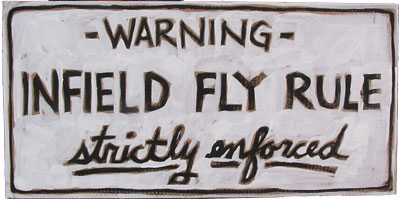
It’s a strange rule at first glance, I know, but it is a good rule and I now know why it needs to be there.
But, not knowing about this rule or why it’s important has not interfered with my love of baseball for lo, these many years. When, in the rare instance that the in-field fly rule is invoked and the batter is ruled out even though no one caught the ball on the fly or tagged any player out, the announcer might say, “The batter is out--in field fly rule.” I might be perplexed by that announcement or I might have just taken a bite of my hot dog and a slug of my soda and not noticed.
On those equally rare occasions when I’m sitting next to a guy like my brother, they might say, “in-field fly rule”. And I would say, “Oh.”
Well, I think that going to church is a lot like this. You need to know a little bit about the church and its worship, but you don’t need to know everything.
You need to know the basics and that is what Confirmation is intended to be.
We learn the Lord’s Prayer, the Doxology, and the 10 Commandments. We learn a bit about the meaning of Holy Communion and about how Jesus is present next to us when we take it.
We need to know something about the sacrament of Baptism--that it is a rite of initiation into the church, a “sacrament of belonging” as the Jesuits put it--but that it might not have much to do with the washing away of original sin as if a child is born with such a condition.
We need to know something about God’s love for us which transcends our every betrayal of God and God’s love for the world.
We need to know about GRACE.
Those things are key it seems to me.
But you don’t need to know everything about the faith.
The Church in its long history has hundreds of “In field fly rules” that govern its life, but you don’t need to know them all in order to be a saint in the body of Christ.
I find that most of the “in-field fly rules” in the church are written in Latin.
“ex opere operatum”,
“Extra ecclesia nolo salus.”
“simil justis et peccare.”
I think these are all treasured formulas to understanding the difficult twists and turns of the faith, but there will be plenty of time to learn about them. I won’t spend time explaining them this morning.
What you need, in the faith, is to be a partner with others in this faith journey.
As a friend of mine at our meeting in Colorado this past week said, “You don’t need a PhD in systematic theology or biblical hermeneutics (that’s one of those in-field fly-rules). All you need is to be with folks whom you trust and just look over their shoulders for a while.”
I remember when I first started attending a United Church of Christ -- well, an E and R Church since it was before the merger that created the UCC --  when I first started attending my church, I held a hymnal in my hands and sat next to my buddy Allen Wallenschlager. I was just 10 years old when I started attending that Church.  My parents were never members of any church, so I attended church with my grade school friends, not with my parents. My parents never forced me to go to confirmation. In fact, I don’t really think they knew what Confirmation was but they were patient with me in my new found love for the church.
Well, I sat next to my buddy Allen most Sundays and I remember my first encounter with the hymnal. When we got to the second line of the first verse, my eyes did not go where they were supposed to go.
So, for example, in the first hymn for today, “Now Thank We all our God” I sang it by going from the first stanza of the first verse “Now thank we all our God with heart and hands and voices”
And then to the first stanza of the second verse, “O may this bounteous God, through all our life be near us”
Allen, who was a gentle soul (Thank God) simply reached over to my hymnal when he heard that I was singing the wrong words and pointed to where I was supposed to be singing. He made it clear in that simple gesture that I wasn’t just to go to the next line of text, but to the next line in the stanza which was in the next measure of music.
Now Allen could have been a bully and told the whole Sunday school class that I didn’t know how to sing a hymn, but he didn’t. As I say, he was a gentle soul. And the Church needs gentle souls above all.
You don’t need a PhD in Church History to be a faithful member of the church of Jesus Christ. What you need is a companion in the faith, someone who will look over your shoulder and gently make corrections. You need someone you trust who will allow you to look over their shoulder from time to time and see how they do things.
You will never know all there is about the Christian Church and its history and theological differences.
I venture to say that even those who know much about the history of the church, disagree even more with others who know much.
In the final analysis, the faith boils down to the simplest of truths. God loves you more than you love yourself.
God the Father
God the Son,
God in the Holy Spirit,
will never leave your side and will be there even when you most doubt his presence.

My brother, to come back to him, has also worked in India and has experienced that mystifying sport called “Cricket.” I said to him two days ago, “Do you understand Cricket” and he said, “Yeah, a bit.” I said, “Do you like it?” He said, “Yeah, I do especially since they have some games reduced to 5 hours rather than 5 days.”
But he did say that you need to know something about a sport in order to enjoy it.
You have to know something.
I told him that I was in a city in southwestern England one March some years ago when a significant world match of Cricket was on. I was the guest of a minister of the church I was visiting and he insisted that I join all the men (and they were all men) in the living room after Sunday dinner, to watch this some-kind-of-championship.
I didn’t have a clue as to what was going on and even though I was enjoying the men and their uproars about things in the game that utterly mystified me, I had no desire to go out of my way to see another game of cricket. I enjoyed being with these friends, but I have never watched another game of cricket.
I note that there are cricket games on TV and there are games played in the Milwaukee area that I could go and watch. And while that would be an odd and enjoyable moment, I think I have better things to do with my free time.
So, my brother said, “You really do have to know SOMETHING about the game in order to enjoy watching it.”
So this is what brings us to this moment.
You, Celia, Jack and Sara, have learned a little about the Church and its faith. You’ve learned that the faith in Jesus Christ is simple if you want it to be or joyfully complex if you want it to be. And the church will find you partners in the journey of the faith that will help you find your place in the hymnal.
Jesus says, “The branch cannot bear fruit by itself unless it abides in the vine,” Do you get that metaphor?
Confirmation by itself is just a seed. In order to bear fruit you need to “abide.” That means you need to live along side of others who are sharing the faith with you so that you begin to understand the faith by living it out.
You may never understand the in-field fly rules of the faith.
But that should never get in the way of loving the faith and living it out in the world God has called us all to love.

Saturday, August 14, 2010


Cruciality—the possibility of no responsibility


Every congregation has a crucial moment. The problem is that we can’t tell which moment among all the million church moments is the most crucial. Or which moments are crucial and which moments are just very important.

For us one of the most crucial moments was the choice of where we would spend our exile following the fire of December fifth of 2005.

Not every community of God’s people gets to choose where it will spend its exile. But we did. The choices after the fire were a Christian elementary school auditorium northwest of us, a Baptist church that wanted to move to an abandoned YWCA where there were two swimming pools, and a college chapel. For a variety of reasons none of them made sense.
Instead we moved our temporary worship space to a Masonic lodge which had no windows and strange symbols that we had to rationalize as part of our new world.
It was free.

We did not pause to think about what “free” really meant. 

The crucial way, the way of the cross, might have involved some measure of responsibility. We might have thought in terms of actually having bills to pay that would transfer over to the time in our new building in which we had actual bills to pay—custodial, utility and mortgage. But here we were confronted with the possibility of no responsibility. What congregation wouldn’t have taken this route?

Cruciality means not being free. It means being bound to the cross of the Crucified Christ, and such binding comes as a surprise to a church whose mind is so much in the middle of the Twentieth century. The late twentieth century American idea of being church is about comfort over the cross and we are not alone in that. The reigning idea of that post-war American church is that Christ has triumphed and we are the heirs of Christ’s kingdom.

Wednesday, May 26, 2010

Beauty of Terribleness


This was not my idea, but it is an idea that has absorbed me from the beginning of my artistic life not to mention my life in the church.
Let me explain.
I have loved the idea of a terrible beauty long before I'd heard that William Butler Yeats gave it a name


Now and in time to be,
Wherever green is worn,
Are changed, changed utterly:
A terrible beauty is born.


The Waukesha fire of 2005 and the oil spill of 2010 have this in common. There is about it all a terrible beauty.
Beauty lies, in part, in contrasts. The night of the fire was deeply cold. I forget really how cold, and I might have the exaggeration of memory, but I just remember standing outside of the fire command post in the parking lot of the church at about 11 p.m. The fire was blazing in front of me and I had not yet been invited in to the warmth of the command post—a trailer sitting in our parking lot. I had put on loafers because that was all I saw at the door when I left my house after the 9:45 phone call telling me that the church was on fire. Melting snow had seeped into the thin souls.
Now I just stood there. Deeply cold, facing a fire the temperature of which were beyond measurement. The assistant fire chief for our city said that his advanced team went in to the narthex of the church just minutes after they were called. They had infra-red scopes to see if there were bodies in the smoke-filled darkness. But these scopes, designed to measure heat, saw only heat at the front of the church. A blazing red-orange filled their scopes such that no bodies could have been seen if they were there.
The December night sky was crystal clear and dark. And the heat was intense enough to obliterate the possibilities of life. The contrasts were enormous. It was a terrible beauty.
Contrasts in art can be overdone, of course. Blue and orange can live together only so long until someone gets the joke. Okay, move on. We see what you're doing.
But for the accidental moment, the terror is beautiful though no one is altogether willing to admit it at the time. One dares not call it beauty while the mourners are gathered, of course. It is just a horror. It is not anything like beautiful. And when this oil spill goes on like it has, it "can make a stone of the heart."
Why, exactly, are there so many stunning pictures of natural disasters? Because beauty and terror live naturally together.
Guernica. There, I've said it. If it were a simple one to one depiction of the 1937 destruction of the Basque city, there would be no remark. But Picasso rendered it with horses' heads raised in horror and bodies strewn and screaming across the horizontal expanse. It is a terrible beauty.

Tuesday, May 25, 2010

Charcoal Fire


We just saw N. T. (Tom) Wright at Elmbrook Church a few weeks ago. He had a marvelous take on the two Charcoal Fires in the Gospel of John. He draws on his own reflections in his book John for Everyone in the "for everyone" series published by Westminster/John Knox.
He starts with John 21:9, "When they came to land, they saw a charcoal fire laid there with fish and bread on it." A charcoal fire. Not an insignificant detail, but in my more than 30 years of ministry, a detail I'd missed. The other charcoal fire is in John 18 where it is written that Peter, his last supper protestations to the contrary notwithstanding in chapter 13, denies Jesus three times by chapter 18. The cock crows after the third time and it all takes place by a charcoal fire.
Put the DVD of Christ's life on fast forward to chapter 21. Another charcoal fire. Another set of three imprecations.


Think back to the smell of that fire [in chapter 18], wafting through the chilly April air. Think of Peter going out in shame, angry with himself, knowing that Jesus knew. Knowing that the beloved disciple knew. Knowing that God knew. And hearing the next day what had happened to Jesus. Not even the resurrection itself could wave a magic wand and get rid of that memory. Nothing except revisiting it and bathing it in God's own healing. (John for Everyone, p. 159)

There's something about smells that carry us back to another time and place, often in pleasant and sometimes in shocking ways. The home where Grandma spent the last days of her life come back to us Pastors when we enter the house of a shut-in whom we visit and smell the residual effects of Ben-Gay and other poultices. Imagine, Tom Wright suggests, the environmental odor of that second charcoal fire on the lakeshore.


The smell of that charcoal fire lingers. Peter's night of agony—and Jesus' own night of agony—returns. But because of the latter, the former can be dealt with. [p. 163]

Peter must have been in two places at once. The charcoal fire of the night of denial and the charcoal fire of the evening of resurrection. In the present fire, Jesus asks him three times, "Simon, son of John, do you love me?" Typical of Peter's impetuousness, he replies "Of course I love you." "Lord you know everything, you know I love you." Wright, the Greek scholar points out that two Greek words are used in this exchange between Jesus and Peter. Where Jesus uses the Greek word "agape" Peter replies with "phileos." Jesus asks Peter for a divine love, but Peter responds with a friendly love. Both are translated as just "love" in English because we don't have much choice. The way Wright put in his lecture at Elmbrook the conversation might have gone like this:


Simon, son of John, do you love me?

To which Simon Peter responds each time,
Lord, of course, you know I am your friend.

But the third time, Jesus comes down to Peter's level and says,
Simon, are you [really] my friend? Then feed my sheep, tend my flock.

In this marvelous exchange, Simon Peter, once entrusted with the keys to the kingdom, but must have been sure that he has lost them in the bramble of his own terror, has now been given them back.


I've thought of those charcoal fires and our own fire of 2005. Have we been given something to do with this marvelous new building?

Advent

I came across this word "adventitious" recently. It means "accidental" or "fortuitous." But it has a deeper sense. We make choices as we move along in the complexities of life and sometimes the choices we make connect with other events around us in a way that make possible things we could not have imagined.

Most of what we do, I suppose, we hope is intentional. But, if we're honest with ourselves, the choices we make often connect with things beyond our control. We try to head off in a direction that makes sense to us, only to discover that other forces larger than we are at work. It could be chaos. Or it could be a divine design that we might trust if we just relax.

The root word for adventitious is advent, of course. And advent means the "coming or arrival, especially of something extremely important" like the advent of the computer or the advent of peace. Usually, but not always, this coming is a surprise. It's like riding a roller coaster. Something's coming over the next peak, but you're not always sure what it might be.

Advent is one of those words rooted in language that is deeper than all current languages. The Indo-European languages share this word meaning "to come." Advent in the Christian tradition is the season of the Church year in which we wait for Jesus to "come" as a child in our midst. The four Sundays prior to Christmas day are the Sundays of Advent. In the romance languages (French, Italian and Spanish) the root word is "ven" as in adventure, souvenir, avenue, circumvent, convention, covenant, intervene, invent, prevent, revenue or the Old French bien venu which means, welcome.

Welcome comes to English via the Germanic languages (English, Dutch, German, Scandinavian). Welcome means a "desireable guest" from wel which means desireable or pleasurable and komen which means "Guest" or "he who comes." Welcome the one who comes no matter who he or she might be.

The strange season of Advent is all about welcoming the stranger. For, as it is written, welcoming strangers may be about entertaining angels unawares (Hebrews 13:2)

A lesson we all learned during our exile after the fire was that we were welcomed by so many without conditions. In turn, we have done a bit of welcoming. A Latino church is now a part of our fellowship. La Viña del Señor is a new church in the Wisconsin Conference led by Mario Navarro. They've been with us for a year and a half worshipping on Sunday afternoons. Already they have moved from strangers to angels.

Monday, September 3, 2007

Groundbreaking


In both senses of that word/phrase. The breaking of the ground on the new/old site as well as a breakthrough moment. We're building on the old site at 413 Wisconsin Avenue. It was a bit of a controversy. There was some who would like us to have gone out beyond the so-called "59 corridor" (the loop that surrounds the city of Waukesha and defines its suburbs). But we decided to stay -- to, as the prophet Jeremiah put it, "seek the welfare of the city..."


On a rainy Sunday morning, following our worship service at the Masonic Lodge, we gathered at the site of the old church. We stood on property which has been in the hands of this congregation for about 140 years. In the midst of a soft rain, we prayed, sang and listened to the Mayor and our alderman tell us how grateful they are that we have decided to rebuild in the downtown area of the city. Several of us spoke of the groundbreaking ceremony that took place in May of 1891 and how great a risk those good folks took in those days just before the turn of the century.


It was a great day. One year to go to that day when the keys are handed over to us. It's hard not to overstate our joy.

Thursday, August 2, 2007

Was it really God's fire?

There is a theological presumption in assuming that this fire was God's. Or "of God." Or howsoever we might style it. This is always the problem with disasters and it has been our problem from the beginning. It reminds me of the public argument between the Niebuhr brothers (Reinhold and H. Richard) in the 1930s. Or a more recent wrestling by N. T. (Tom) Wright, bishop of Durham, England, on the place of God in the war on terror. If God is sovereign over all things and God is "all in all" and (most difficultly), God is good then God is present in all things and it is our most difficult work to discern God's presence and God's will for our time.

The problems that Tom Wright addresses are only tangentially related to this Waukesha fire of December of 2007. It is a kind of conceit to place our small problems of the loss of a 114 year-old building in the same context or breath as Darfur, Gaza, 9-11 or Baghdad. In a certain way, this fire, like the collapse of the Minneapolis bridge yesterday, is just an accident and we shouldn't try to find any larger theological motifs in it. A good friend of mine who also pastors a church which was consumed by fire, wryly observed that he was glad that the fire officials in finding a cause for the fire didn't call it "an act of God." Fires, collapsing of bridges and the like are not, of course, "acts of God" as insurance companies like to label them.

Still, there is somewhere in all of this, the presence of God, the will of God and, I trust and I know in my very marrow, the goodness of God.

To return to Tom Wright's article cited above, the most important problem for most Christians is the inability of most of us, especially mainstream liberal Christians, to speak of God at all in public. Or even to suggest that God has a role to play in any public event, good or evil. For Wright, Jesus gives us a clue as to the whereabouts of God and the role God plays in public:
It means that whenever we ask the question of where God is in the world – whether in the world in general, or in the Tsunami or the Holocaust or the War on Terror, we should look first for God where the night is darkest and the pain is worst, not in the blaze of glory and the blast of trumpets but in the cry of the baby and the scream of the tortured.
To say that our fire of December is a "fire of God" is only to say that we will understand our current dilemma differently if we somehow understand that it is "of God" in some deeply mysterious way. Our journey thus far--still homeless as we are--has been largely about that process of discovery and hope.